Hi there.
I wrote a mystery novel.
It’s called Tucson ’93.
It involves a mystery and it takes place in Tucson during the summer of 1993.
And I’m excited for everyone to get a chance to read it.
This is the FAQ
We are less than two weeks away from the launch of Tucson ’93 and I’m getting antsy. I’ve made some list minute (and nerve wracking) edits. I started incorporating the paperback version of the book into my marketing. And I even dipped out of the country for a bit to hang with one of my kids.
I’m also at the point where Tucson ’93 feels more like a product, than a book right now. So, like any new product that is about to hit the market, I decided it needs an FAQ. As usual with these blogs, this one goes off the rails rather quickly, but hopefully it will answer the burning questions you didn’t know you had about this book, which you can preorder here.
How many pages/words is Tucson ’93?
Tucson ’93 rounds home at 221 pages and just over 66,000 words.
What’s my return on investment? I’m a busy person and I’d appreciate a measurable ROI.
Umm, well, I’d like to think of this as a piece of art and a commentary on the untreated collective trauma of Generation X, but if you insist, let’s do the math. If you buy the Kindle edition for $4.99, you are essentially paying one cent per 132 words. That seems like an incredible bargain to me.
If you buy the paperback, the math is a bit different. At $14.99, now you are kicking me a penny for every 44 words. Seems like a worse deal, but you are also getting a physical object. If you like the book after reading it, you can graciously give it to a friend; if you hate it, hype it up and then offload it on an enemy. I don’t suggest burning it, but the pages could come in handy if you need to start a fire.
What’s up with the snake on the cover? I don’t like snakes.
The rattlesnake on the cover directly relates to what you might call the “inciting incident” of the book. Other than that, snakes don’t play a starring role.
Since you mentioned starring roles, what kind of name is Uri LaFleuer for your main character? Sounds kind of weird.
I didn’t realize this FAQ was a two-way discussion, but I’ll go with it. On one level, do names really matter? Does “Sherlock Holmes” scream normal? That said, I fully admit it doesn’t stack up to some other private investigators in literature. Sam Spade, Mike Hammer, Easy Rawlins are way cooler. Maybe I should have tried harder. On another level, there is a deeper meaning to Uri’s name that has to do with “otherness”, but I’m not going to explain that here.
Ooh, sounds serious. Okay, well how about this: do people swear a lot in this novel? I also don’t like that.
I regret to inform you that the F-word is used 159 times, which comes out to rough once every 1.4 pages. Is that a lot? I don’t fucking know.
This back of the book mentions mixtapes. What’s up with that?
I’m not sure how to answer that rather vague question but let me give it a shot. Music plays a big role in this book. Uri loves alternative music, especially grunge, and dreams of moving to Seattle. His best friend, Pablo, is into hip hop, with a bias towards what is happening on the East Coast. The two of them exchange mixtapes in the beginning of the story. Uri also spends a lot of time in his car, so listening to music is core to that experience. There are a lot of music references in the novel, so if you’d like to listen as you read along, sign up for my newsletter and I’ll send you the Spotify playlist.
Can you explain what slacker noir is? And did any slacker noir novels or movies inspire Tucson ’93?
In my opinion, its easier to show what slacker noir is than try to explain it. For example, the ultimate expression of slacker noir in popular culture is The Big Lebowski. Is Tucson ’93 like that Cohen bros. classic? Not really, although it’s certainly inspired by it. And while they take place during a similar time period (1990 for TBL), both the settings and the ages of the characters create significant differences. For example, navigating Tucson is a lot different than navigating Los Angeles, and because Uri is 24 and Jeffrey “The Dude” Lebowski is supposedly in his 40s, one is in a rec basketball league while the other bowls.
Except on Shabbos.
In literature (and I don’t consider myself well-read enough to really know this answer), the prime example is Inherent Vice by Thomas Pynchon, which also was a source of inspiration for Tucson ’93. Comparing my writing to Pynchon’s is like comparing a toddler learning to walk with a world-class sprinter on an alien planet who can do cartwheels and backflips on their way to victory. What he does is at a level so high up I can’t even see it, let alone fully comprehend.
All that being said, I think Uri LaFleur is more slacker noir adjacent. Yes, he hangs out with stoners and mostly has no idea what he’s doing, but he also is trying relatively hard and doesn’t give up. He wants to be a professional even if he can’t quite pull it off.
I’ve seen pictures of middle-aged dudes wearing Tucson ’93 merch. Are you really selling that stuff?
I never imagine I’d be selling t-shirts at this stage of my life, but let’s chalk it up to the demands of late-stage capitalism and a killer cover design that simply cannot be contained on just a paperback. But yes, I’m selling t-shirts, hoodies, stickers, and even a mug. I’m working on a poster, but that is going to slip until after the launch.
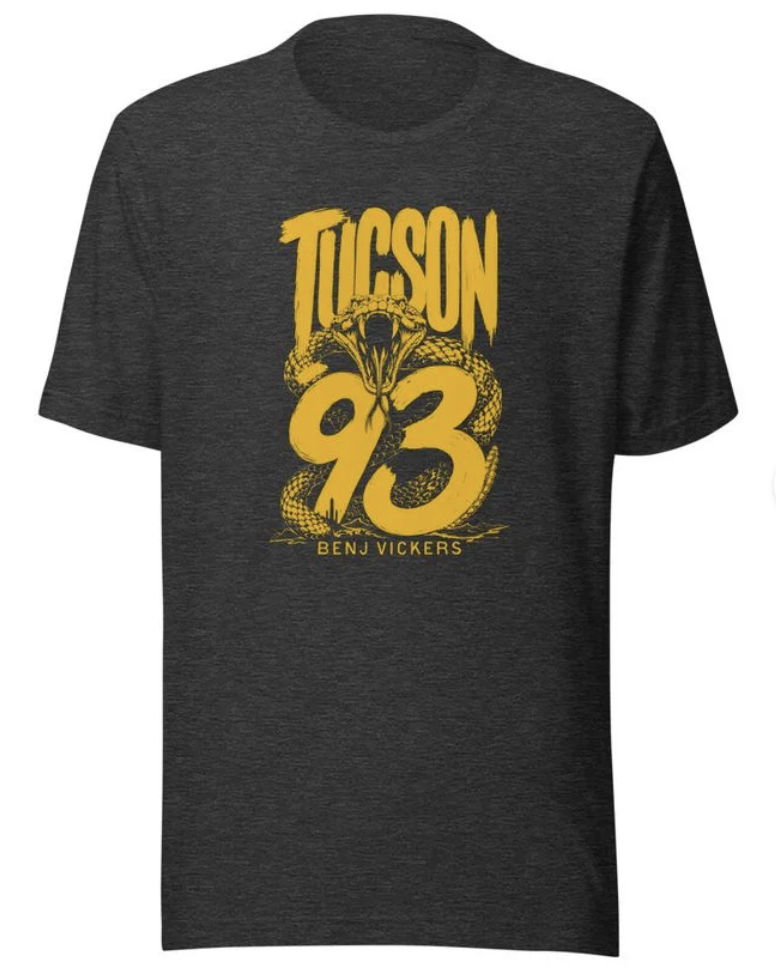

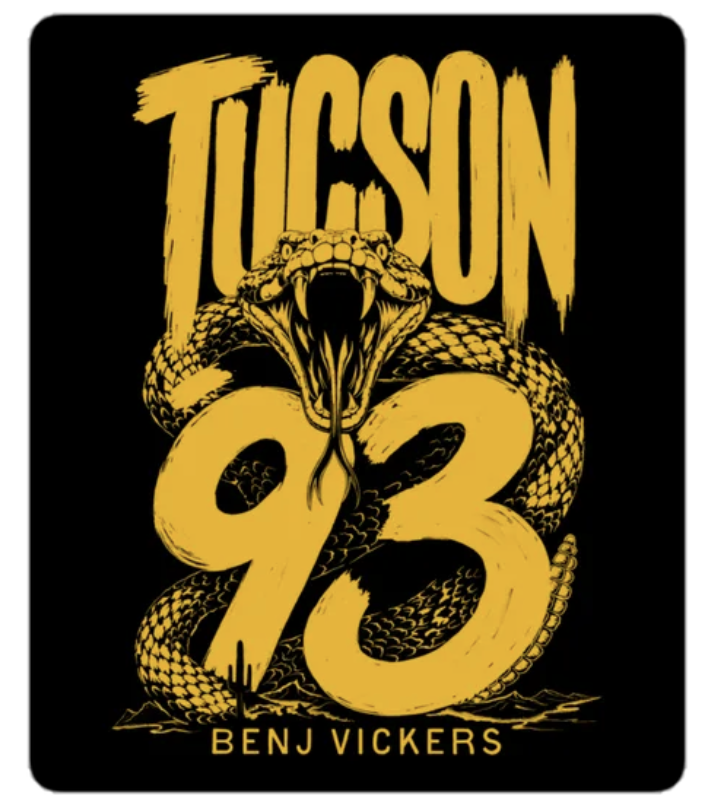

I’ve heard that in this book everyone is mad about CAP water. Can you explain what that is?
I’ll try do this quickly. CAP, which is short for the Central Arizona Project, is a 335 mile canal that diverts water from the Colorado river up near Lake Havasu down through southern Arizona. Hopefully this isn’t news to you, but a lot of Arizona is a desert and water isn’t plentiful. The goal of CAP was/is to support agriculture and a growing population throughout Arizona. The original legislation to create this canal was signed way back in 1968, but construction wasn’t completed until the early 1990s.
When this water finally made its way to Tucson, many residents complained that it looked brown. Tucson ’93 takes place in the middle of that time. I should note that this problem was eventually resolved and is not an issue today. And if you haven’t heard, Arizona’s reliance on the Colorado river is in big trouble today.
Since this book is barely over 200 pages, I’m going to finish it over a weekend. What should I do next?
Buy another copy? No, what you should do is write a review. I’m not sure how these mysterious algorithms work, but word on the street is that reviews make a big difference. Even if it’s just a few sentences on your favorite scene, questionable usage of pedestrian adjectives, or confusion about swamp coolers, future readers would like to hear from you.
Is Tucson ’93 the start of a series? Don’t tell me the next one is going to be called Tucson ’94.
Yes, the goal is for the adventures of Uri LaFleur to continue. I’m planning for his story to play out over four books, which might be called a tetralogy or a quadrilogy or something else I never heard of before I searched it up online. And no, the next book isn’t going to be called Tucson ’94.
It takes place in February (Rodeo time!) of 1995, so it can only be called Tucson ’95.